
Physics as a science and the scales of the universe
Why can physics study both a proton and the whole universe, even though their sizes are so far apart?
Prior knowledge
- Powers from lower secondary school mathematics, for example $10^{3} = 1000$ and $10^{-2} = 0.01$
- The units of length: metre, millimetre and kilometre
Core path: follow the steps in order. Tasks marked Optional give extra practice. Optional tasks: 6.
Think about it
Physics studies the smallest and the largest structures we know with the same principles. The size of a proton is about $1.7\cdot10^{-15}\,\text{m}$ and the diameter of the observable universe about $8.8\cdot10^{26}\,\text{m}$. Neither can be seen with the naked eye or measured with a metre rule, and yet their sizes are known.
What is matter made of, what larger structures is Earth a part of, and how many powers of ten are there between the smallest and the largest size?
Optional Review from lower secondary school
Predict
Make your predictions before investigating 2 questions
Prediction 1: an atom and its nucleus
Prediction 2: the Solar System and the Milky Way
Investigate
Zoom from the Planck length to the observable universe. All the objects that fit in the picture are shown at the same time in the right proportions of size, and the bar at the bottom shows how long a power of ten of metres is on this scale.
Simulation
How to use
Choose an object from the menu Go to object, and the picture slides to the scale where that object is the nearest in size. The buttons Zoom in by a factor of $10$ and Zoom out by a factor of $10$ change the width of the view to a tenth or ten times as much. The objects stand side by side by size: the smallest on the left, and an object larger than the picture is cut off at the edge of the picture. An object a few pixels in size is a dot, and a line points from it to its name. You can also drag the Width of the view slider, drag the picture sideways or click a place on the map. Start zooms automatically, and Direction and Speed choose the direction and the pace. The dots on the map are objects, and the light band shows which sizes fit in the picture now.
Assumptions of the model
The sizes are rounded order-of-magnitude values, not exact measurement results. The values are rounded model values from the literature: the Planck length is a quantity calculated from constants of nature, the astronomical unit $1\,\text{AU}$ and the light-year are agreed definitions, the sizes of the proton and the atom are based on scattering experiments and the quantum mechanical model, the size of the Milky Way is an estimate (about $10^{5}$ light-years, uncertainty tens of percent) and the diameter of the universe is inferred from observations with a cosmological model. The sizes of a hair, a red blood cell, an ant, a coin, a ball, a whale and a person are typical values, and individuals vary. The size of a quark is an upper limit obtained from observations. The size of a water molecule is a typical value, the diameter of a neutron star is a typical value based on observations and models (about $20$–$25\,\text{km}$), and for the black hole Sgr A* at the centre of the Milky Way the size drawn is the diameter of its event horizon, calculated from its mass (about $4.3$ million solar masses). A black hole is not a solid sphere: the boundary drawn is the event horizon, and the gas glowing around it and the radiation beams of a neutron star are illustrations. The sizes of nuclei, atoms and the Moon and Jupiter are rounded table values. The drawings are illustrations. At the Planck length the grid is only a symbol, because there are no observations of the structure of length. The electron cloud of a hydrogen atom is a probability picture, and its nucleus is drawn too large. On the orbits, stars and planets are enlarged dots, and the size marked for the orbits is their radius, although the picture is drawn by diameter. The Milky Way and the universe are artists' impressions.
How the calculation works
The width of the view $W$ corresponds to $560$ pixels in the picture. An object of size $d$ is drawn in the picture with a width of $\dfrac{d}{W}\cdot560$ pixels. For example, when the width of the view is $10^{-9}\,\text{m}$, a hydrogen atom is $\dfrac{1.1\cdot10^{-10}\,\text{m}}{10^{-9}\,\text{m}}\cdot560 \approx 62$ pixels wide. An object is visible when its size is about $\dfrac{1}{1000}$–$3$ times the width of the view: an object under $4$ pixels is a dot, and an object larger than the picture is cut off at the edge. The number on the slider is the exponent of the width: the number $-9$ means a width of $10^{-9}\,\text{m}$. When the view zooms out tenfold, all objects shrink to a tenth.
Experiment 1: the steps of matter
Test prediction 1. In the initial state the nearest object in size is the water molecule. Press Record measurement. Then use the Go to object menu to select a hydrogen atom, a proton and a quark in turn, and record a row for each. The $n$ in the table gives the order of magnitude of the nearest object: the size of the object is about $10^{n}\,\text{m}$. The value for the quark is an upper limit.
Initial state: $L$ = $-9$. Kept constant: nothing. Varied: object.
| object | $n$ |
|---|
Use the rows of the hydrogen atom and the proton in the table. By how many orders of magnitude is the hydrogen atom larger than its nucleus?
Hint 1: a guiding question
From the table you get the exponent $n$ of the order of magnitude of both objects. The nucleus of a hydrogen atom is a single proton.
Hint 2: what is the connection
Calculate how many steps of powers of ten there are from the order of magnitude of the proton to that of the hydrogen atom. The number of steps is the difference of the exponents, the smaller subtracted from the larger.
Hint 3: an intermediate step
If the row of the hydrogen atom has $n = -10$ and the row of the proton $n = -15$, the number of steps is $-10 - (-15)$.
Show the solution
Given
from the table, in the row of the hydrogen atom $n_\text{atom} = -10$ and in the row of the proton, that is, the nucleus of the hydrogen atom, $n_\text{proton} = -15$
Find
the difference of the orders of magnitude, that is, the number of steps of powers of ten between the atom and its nucleus
Principle
The exponent $n$ tells which power of ten the size is in. Each step from one power of ten to the next is a tenfold size, and the number of steps is the difference of the exponents, the smaller subtracted from the larger.
Formula
$\text{steps} = n_\text{atom} - n_\text{proton}$
Conversions
Not needed: the exponents are numbers without a unit.
Substitution
Answer
$5$
Orders of magnitude; the number is an integer, because $n$ is rounded to a whole power of ten.
Reasonableness
Five steps mean about $10^{5}$, that is, a hundred-thousandfold size. The exact ratio is
which is close to that. The difference is much smaller than the ten orders of magnitude between an atom and a person.
Experiment 2: Earth's address
Test prediction 2. In the initial state the nearest object in size is Earth. Record a row. Then use the Go to object menu to select the Sun, the radius of Neptune's orbit and the Milky Way in turn, and record a row for each. If you like, continue all the way to the observable universe.
Initial state: $L$ = $7{.}7$. Kept constant: nothing. Varied: object.
| object | $n$ |
|---|
Optional Optional experiment: where is the midpoint of the sizes?
In the initial state the nearest object in size is the observable universe. Record a row. Then use the Go to object menu to select the Planck length and record a second row. In the question, calculate the midpoint between these two. Then zoom to the object in the model whose size is closest to this midpoint, and record a third row: the simulation shows which object is in the middle. Guess first: is the human in the middle of the sizes?
Initial state: $L$ = $27{.}5$. Kept constant: nothing. Varied: object.
| object | $n$ |
|---|
Calculate the mean of the $n$ values of the smallest and the largest object, that is, the midpoint on the axis of orders of magnitude.
Then zoom to it, record the third row and answer: what is the $n$ of the nearest object in the simulation?
Hint 1: a guiding question
Choose the rows of the Planck length and the universe in the table and read their $n$ values.
Hint 2: what is the connection
The midpoint is the mean of two numbers,
Use the exponents, not the sizes in metres.
Hint 3: an intermediate step
If $n_\text{min} = -35$ and $n_\text{max} = 27$, then $n_\text{mid} = \dfrac{-35 + 27}{2}$. Then find the object whose size is about $10^{-4}\,\text{m}$, and record the third row.
Show the solution
Given
from the table, in the row of the Planck length $n_\text{min} = -35$ and in the row of the universe $n_\text{max} = 27$
Find
the exponent of the midpoint $n_\text{mid}$
Principle
The sizes are in many different powers of ten, so "in the middle" means the same number of orders of magnitude from each end. It is the mean of the exponents, not the mean of the sizes in metres.
Formula
Conversions
Not needed: the exponents are numbers without a unit.
Substitution
Answer
$-4$
That is, a size of about $10^{-4}\,\text{m}$; an integer, because the exponents are integers. When you zoom here, the nearest object in the simulation is a hair, whose $n = -4$: the calculated midpoint and the object in the simulation agree.
Reasonableness
From the midpoint to the Planck length it is $-4 - (-35) = 31$ orders of magnitude and to the universe $27 - (-4) = 31$ orders of magnitude, so the gap is symmetric. The size $10^{-4}\,\text{m}$ is a tenth of a millimetre, about the thickness of a hair.
Optional How were the sizes found out?
No size in the simulation is the result of a single tape measure. Every size has been inferred from measurements and a model, and the method varies with the scale.
- Proton, $1.7\cdot10^{-15}\,\text{m}$: scattering of electrons from protons and measuring the energy levels of atoms.
- Virus, $1.0\cdot10^{-7}\,\text{m}$: the electron microscope.
- Earth, $1.27\cdot10^{7}\,\text{m}$: geodetic measurements and satellites.
- Radius of Earth's orbit (1 AU), $1.5\cdot10^{11}\,\text{m}$: radar measurements of planets and probes.
- Nearest star, $4.0\cdot10^{16}\,\text{m}$: the apparent shift of the star as Earth orbits the Sun (parallax).
- Universe, $8.8\cdot10^{26}\,\text{m}$: observations of galaxies and a model of expansion.
Theory summary
Key idea
Physics builds models and tests them
Physics is a natural science that looks for regularities in nature and explains them with models. A model is a simplified description of how a phenomenon works. From a model you can work out a prediction, and a measurement can disprove that prediction. So physics does not rely on who says something, but on what experiments and measurements show.
Research proceeds in cycles. An observation raises a question, a model is proposed to answer it, and a prediction is derived from the model. The prediction is tested in an experiment, and the result either supports the model or forces us to change it. A measurement gives its result as a number and a unit: the SI unit of length is the metre, $\text{m}$.
Sizes vary by powers of ten
The objects of physics come in hugely different sizes: a proton is about $1.7\cdot10^{-15}\,\text{m}$ and the observable universe about $8.8\cdot10^{26}\,\text{m}$. A range this wide cannot be written as ordinary numbers. That is why we use scientific notation $a\cdot10^{n}$, where $1 \le a < 10$ and $n$ is an integer. When the exponent $n$ grows by one, the number becomes ten times larger. The Planck length, about $1.6\cdot10^{-35}\,\text{m}$, is a scale below which, according to physicists, current theories no longer work. It has not been measured directly but calculated from constants of nature.
Order of magnitude tells the rough size
The order of magnitude is the power of ten that is closest to the number on the axis of powers of ten. The order of magnitude of $a\cdot10^{n}$ is $10^{n}$ when $a$ is less than about 3, and $10^{n+1}$ when $a$ is more than about 3. A person's height $1.7\,\text{m}$ is of the order $10^{0}\,\text{m}$, but the height of Mount Everest, $8.8\cdot10^{3}\,\text{m}$, is of the order $10^{4}\,\text{m}$.
The sizes of objects are rounded values: people, ants and galaxies are not all the same size. That is why the order of magnitude is often enough for a comparison, and it is worth asking how accurate the numbers are.
How many times larger?
When you want to know how many times larger one thing is than another, divide the larger size by the smaller:
$$k = \frac{d_\text{larger}}{d_\text{smaller}}$$
Here $k$ is the ratio of the sizes, that is, how many times larger the object is. Both sizes must be in the same unit. Then the unit cancels, and $k$ is just a number.
Powers of ten let you estimate the ratio in your head. Each step from one power of ten to the next is a tenfold size. A hydrogen atom is of the order $10^{-10}\,\text{m}$ and a proton $10^{-15}\,\text{m}$. There are five steps between them, so the atom is about $10\cdot10\cdot10\cdot10\cdot10 = 10^{5}$, that is, a hundred thousand times larger than the proton. The number of steps is the difference of the exponents: $-10-(-15) = 5$.
A light-year is a unit of length
Distances between stars are so large that the metre is impractical. A light-year is the distance that light travels in a vacuum in one year, about $9.46\cdot10^{15}\,\text{m}$. So it is a length, not a time. Light travel times and the astronomical units of length are covered in more detail in the chapter Quantities, units and the SI system.
The structure of matter
Matter consists of nested structures
All the matter around us consists of atoms. Atoms can join together to form molecules: a water molecule has one oxygen atom and two hydrogen atoms. At the centre of every atom there is a small atomic nucleus, and electrons move around it. The nucleus consists of protons and neutrons, and each of these consists of three quarks. Quarks and the electron are elementary particles: as far as we know they have no smaller parts, and no size has been measured for them. According to experiments they are smaller than about $10^{-18}\,\text{m}$.
An atom is tens of thousands of times larger than its nucleus
The diameter of an atom is about $10^{-10}\,\text{m}$, but that of the nucleus is only $10^{-15}$–$10^{-14}\,\text{m}$. There are four or five orders of magnitude between them, so the atom is tens of thousands of times larger than its nucleus. If an atom were enlarged to the size of a football stadium, the nucleus at its centre would be the size of a pea. Even so, the nucleus holds over 99.9 percent of the mass of the atom. The size of the atom is set by the region where the electrons move, and the nucleus is small and very dense at its centre. The nucleus of a hydrogen atom is a single proton.
Structures of the universe
Earth's address in the universe
Earth is a planet: it orbits a star, the Sun, and the Moon orbits Earth. A star is a hot ball of gas that produces its own light in nuclear reactions in its core. A planet does not produce light, but it is visible because it reflects the light of its star. The Sun, its eight planets with their moons, and the dwarf planets, asteroids and comets form the Solar System. It is one planetary system among many: thousands of planets orbiting other stars are already known.
The Sun is one of the hundreds of billions of stars in the Milky Way. The Milky Way is a galaxy, that is, a huge collection of stars, gas and dust held together by gravity, and its diameter is about $10^{5}$ light-years. There are an estimated hundreds of billions of galaxies in the observable universe. They form groups of galaxies and larger clusters of galaxies: the Milky Way and the Andromeda Galaxy belong to the Local Group. Groups and clusters form superclusters, and on the largest scale the galaxies lie in web-like filaments with almost empty regions between them.
The edge of the Solar System depends on what is measured
The Solar System has no single sharp edge. Particles flow out from the Sun, the solar wind, which blows a bubble around it, the heliosphere. Its boundary, the heliopause, is about $120\,\text{AU}$ from the Sun, and the Voyager probes have crossed it. However, the Sun's gravity dominates much farther away. From the orbits of long-period comets we conclude that a swarm of comets, the Oort cloud, orbits the Sun far away, about $2000$–$100\,000\,\text{AU}$ from it. So the Voyagers are in interstellar space but still within the reach of the Sun's gravity.
Types of objects, not steps
Not all astronomical objects are steps in the same nested series. Instead, they are found inside galaxies, among the stars. A nebula is a cloud of gas and dust; for example, new stars are forming in the Orion Nebula. A neutron star is the remnant of the explosion of a massive star. Its mass is usually greater than that of the Sun, but its diameter is only about $20$–$25\,\text{km}$, because the matter has been squeezed into almost pure neutrons.
A black hole is a region from which, because of gravity, nothing, not even light, can escape. It has no surface: its size is given as the diameter of its boundary, the event horizon, which grows with the mass. The black hole at the centre of the Milky Way has a mass of about four million solar masses and an event horizon diameter of about $2.5\cdot10^{10}\,\text{m}$. So size does not tell the type of object: a neutron star is smaller than Earth, and this black hole is larger than the Sun.
The observable universe is not the whole universe
The observable universe is the part of the universe from which light has had time to reach us during the age of the universe, about 13.8 billion years. Its diameter is about $8.8\cdot10^{26}\,\text{m}$, or about 93 billion light-years. The number is greater than twice 13.8 billion light-years because space has expanded during the light's journey. The boundary of the observable universe is not the edge of the universe but the limit of our horizon: for an observer in another galaxy, the observable universe is a sphere around that observer. The size of the whole universe is not known, and it may be infinite.
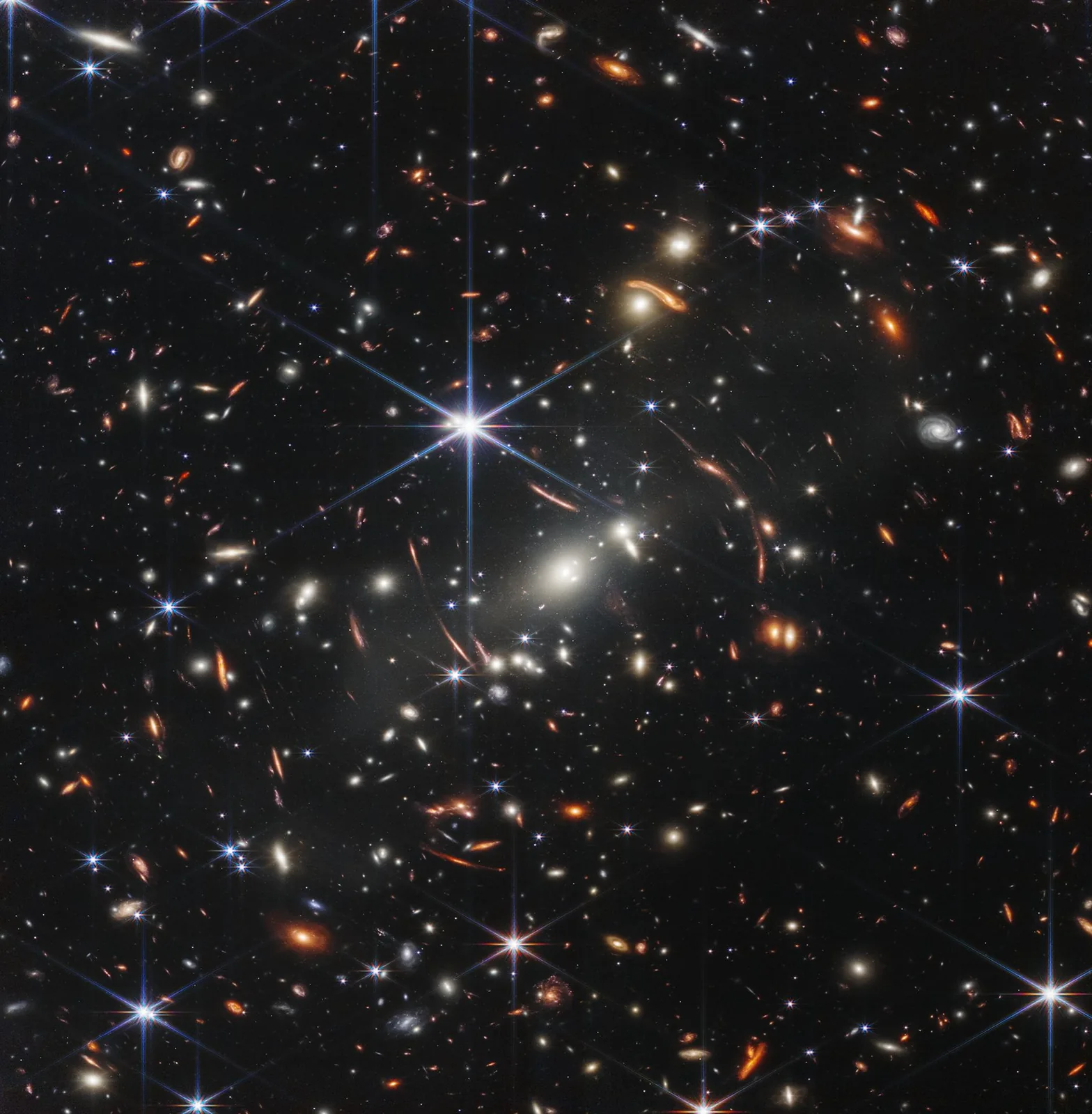
Fundamental interactions
Four fundamental interactions
Structures stay together and change because of interactions. All known interactions come down to four fundamental interactions:
- Gravity acts between all objects that have mass, and it is always attractive. It keeps the Moon around Earth and the planets in their orbits around their stars, and it gathers clouds of gas into stars and galaxies.
- The electromagnetic interaction acts between electrically charged particles: opposite charges attract and like charges repel each other. It keeps the electrons around the nucleus in an atom, binds atoms into molecules and causes electric and magnetic phenomena, such as the ability of a rubbed balloon to attract bits of paper.
- The strong interaction binds quarks into protons and neutrons. Its residual effect holds protons and neutrons together in a nucleus, even though the protons repel each other electrically. It reaches only a distance the size of a nucleus, about $10^{-15}\,\text{m}$.
- The weak interaction causes some radioactive decays. For example, in beta decay a neutron in the nucleus changes into a proton, and an electron and a particle called an antineutrino leave the nucleus. The weak interaction is also involved in the Sun's energy production.
Scale decides which interaction dominates
The same four interactions act everywhere, from inside the nucleus to clusters of galaxies, but the scale decides which of them dominates. The strong and weak interactions reach only the scale of the nucleus. Between particles the electromagnetic interaction is enormously stronger than gravity, but large objects are almost neutral: their positive and negative charges cancel each other's effect. Between particles gravity is the weakest, but it is always attractive and grows with mass. That is why gravity dominates on the scale of planets, stars and galaxies.
Common misconception
A difference in powers of ten is not a difference in sizes. If the orders of magnitude of two objects differ by six, one is not six times larger but $10^{6}$, that is, a million times larger. In addition, a scale picture can show truthfully only one scale at a time: everything cannot be drawn in the same picture in the right proportions.
Neutron stars and black holes are not steps larger than a galaxy, but objects inside galaxies. A black hole also does not suck in everything around it: far from it, its gravity is the same as that of any object of equal mass, and stars can orbit it like planets orbit the Sun.
Summary
- Physics builds models from which predictions are derived, and an experiment or measurement decides whether the model holds.
- Scientific notation $a\cdot10^{n}$ writes very small and very large numbers briefly; one step in the exponent means a tenfold size.
- The order of magnitude is the nearest power of ten on the axis of powers of ten. The ratio of sizes is found by dividing the larger size by the smaller, and each step of a power of ten is a tenfold size.
- A light-year is the distance light travels in a year, about $9.46\cdot10^{15}\,\text{m}$.
- Molecules consist of atoms, atoms of a nucleus and electrons, the nucleus of protons and neutrons, and these of quarks. An atom is tens of thousands of times larger than its nucleus.
- Earth is a planet that orbits a star. The Solar System is one planetary system in the Milky Way, and the Milky Way is one of the hundreds of billions of galaxies of the observable universe.
- Nebulae, neutron stars and black holes are types of objects inside galaxies, not steps of structure.
- The four fundamental interactions are gravity and the electromagnetic, strong and weak interactions. On small scales the interactions of the nucleus and the atom dominate, and on large scales gravity.
Return to your predictions
Compare your predictions with the readings of the simulation. How big is the difference between an atom and its nucleus, and how are the Solar System, the Milky Way and the observable universe related? Which difference in sizes surprised you most? Also return to the question at the start: from a proton to the observable universe there are about $27-(-15) = 42$ orders of magnitude, and from the Planck length about 62.
Would you change your prediction?
Apply
Worked example
Problem
The diameter of a hydrogen atom is about $1.1\cdot10^{-10}\,\text{m}$ and the diameter of a proton about $1.7\cdot10^{-15}\,\text{m}$. How many times larger is a hydrogen atom than a proton, and how many powers of ten are there between their orders of magnitude?
Step 1/7
Given and find. The diameter of the hydrogen atom is $d_\text{atom} = 1.1\cdot10^{-10}\,\text{m}$ and the diameter of the proton is $d_\text{proton} = 1.7\cdot10^{-15}\,\text{m}$. We are asked for the ratio of the sizes $k$ and the number of steps of powers of ten.
Step 2/7
Principle. The question "how many times larger" is a division: divide the larger size by the smaller. The number of steps is the difference of the exponents of the orders of magnitude.
Step 3/7
Rearranged formula. $$k = \frac{d_\text{atom}}{d_\text{proton}}$$
Step 4/7
Unit conversions. None needed: both sizes are in metres, so the unit cancels and $k$ is just a number.
Step 5/7
Substitution. $$\begin{aligned} k &= \frac{d_\text{atom}}{d_\text{proton}} \\ &= \frac{1.1\cdot10^{-10}\,\text{m}}{1.7\cdot10^{-15}\,\text{m}} \\ &= 6.47\ldots\cdot10^{4} \\ &\approx 6.5\cdot10^{4} \end{aligned}$$
On a calculator, the division $1.1\cdot10^{-10} : 1.7\cdot10^{-15}$ is done by entering the powers of ten with the power-of-ten key, which is often called EE or EXP.
Step 6/7
Result. A hydrogen atom is about $6.5\cdot10^{4}$, that is, about 65 000 times larger than a proton. The result is given with two significant figures like the initial data. The orders of magnitude are $10^{-10}\,\text{m}$ and $10^{-15}\,\text{m}$, so the number of steps is $-10 - (-15) = 5$.
Step 7/7
Reasonableness. Five steps mean about $10^{5}$, that is, a hundred-thousandfold size, and $6.5\cdot10^{4}$ is close to that. Order-of-magnitude check: if the proton were enlarged to the size of a millimetre, the atom would be $65\,000\,\text{mm} = 65\,\text{m}$, that is, of the order of tens of metres.
Identify the object
Which interaction?
Optional Find the error
Optional Optional: measuring the size of Earth
Two surveyors stand on the same north–south line at a distance of $8.0\cdot10^{2}\,\text{km}$ from each other. At midday the Sun is directly overhead for one, but a vertical stick of the other surveyor casts a shadow showing that the Sun's ray is at an angle of $7.2^\circ$ to the stick. The Sun is so far away that its rays are parallel, so the angle $7.2^\circ$ is also the arc angle between the surveyors as seen from the centre of Earth. Earth is a sphere.
What is the diameter of Earth? Answer in kilometres.
Hint 1: a guiding question
Around the whole globe the arc angle is $360^\circ$. How many times does the angle $7.2^\circ$ fit in it?
Hint 2: what is the connection
The circumference is
where $s$ is the distance between the surveyors. The diameter is found from the circumference of a circle $C = \pi d$.
Hint 3: an intermediate step
$\dfrac{360^\circ}{7.2^\circ} = 50$, so $C = 50\cdot8.0\cdot10^{2}\,\text{km}$. Then $d = \dfrac{C}{\pi}$.
Show the solution
Given
the distance between the surveyors $s = 8.0\cdot10^{2}\,\text{km}$ and the arc angle $\alpha = 7.2^\circ$; Earth is a sphere
Find
the diameter of Earth $d$ in kilometres
Principle
The distance between the surveyors is the same fraction of the circumference as the angle $7.2^\circ$ is of the whole turn $360^\circ$. The diameter is found from the circumference, because the circumference of a circle is $\pi$ times the diameter.
Formula
so $C = \dfrac{360^\circ}{\alpha}\,s$, and $C = \pi d$, so
Conversions
Not needed: the distance is already in kilometres and the angles are in the same unit (degrees), so the angle units cancel.
Substitution
Answer
$1.3\cdot10^{4}\,\text{km}$
That is, about $13\,000\,\text{km}$, two significant figures like the given measurements ($12\,700$ also fits in the field).
Reasonableness
The known diameter of Earth is $1.27\cdot10^{7}\,\text{m} = 1.27\cdot10^{4}\,\text{km}$, and the result agrees. The circumference $4.0\cdot10^{4}\,\text{km}$ is of the order $10^{4}\,\text{km}$, which corresponds to the size of the globe.
Check your understanding
Exit ticket
Answer on your own first and only then open the answer.
- A nucleus contains protons, which repel each other electrically. Which fundamental interaction still holds the nucleus together, and why does it not pull atoms that are farther apart together?
Answer
The strong interaction, more precisely its residual effect between protons and neutrons. At distances the size of a nucleus, about $10^{-15}\,\text{m}$, it is stronger than the electric repulsion of the protons, but it does not reach beyond the nucleus, so the nuclei of different atoms are not pulled together by it.
- Why is a model tested with an experiment in physics, even if it is logical and beautiful?
Answer
Even a logical model can describe nature wrongly. Only a measurement tells whether a prediction derived from the model matches nature. If it does not, the model is changed or rejected.
1. Concept
2. Difference of orders of magnitude
3. Calculation
The diameter of the Sun is $1.39\cdot10^{9}\,\text{m}$ and the diameter of a neutron star is about $2.4\cdot10^{4}\,\text{m}$, although the mass of a neutron star is greater than that of the Sun.
How many times larger is the diameter of the Sun than the diameter of the neutron star?
Hint 1: a guiding question
The question "how many times larger" is a division: divide the larger size by the smaller.
Hint 2: what is the connection
The ratio of the sizes is
Hint 3: an intermediate step
Calculate with a calculator and check: the number of steps is $9-4 = 5$, so the answer should be close to $10^{5}$.
Show the solution
Given
the diameter of the Sun $d_\text{Sun} = 1.39\cdot10^{9}\,\text{m}$ and the diameter of the neutron star $d_\text{neutron star} = 2.4\cdot10^{4}\,\text{m}$
Find
the ratio of the sizes $k$ (how many times larger the diameter of the Sun is than the diameter of the neutron star)
Principle
The question "how many times larger" is a division: divide the larger size by the smaller.
Formula
Conversions
Not needed: both diameters are in metres, so the unit cancels and $k$ is just a number.
Substitution
Answer
about $5.8\cdot10^{4}$, that is, $58\,000$ times; two significant figures, because the diameter of the neutron star $2.4\cdot10^{4}\,\text{m}$ is given with two.
Reasonableness
The orders of magnitude are $10^{9}\,\text{m}$ and $10^{4}\,\text{m}$. There are five steps of powers of ten between them, so the ratio should be about $10^{5}$, and $5.8\cdot10^{4}$ is close to that. So the neutron star is smaller than many a city, although its mass is greater than that of the Sun: size tells neither the type nor the mass of an object.
Suggestion: one answer does not show everything you can do, but review the theory summary and do the core exercises.
Optional 4. Explain
Explain in your own words what the difference of orders of magnitude tells about the sizes of two objects, and why the simulation cannot show, for example, the Milky Way and an atom in the same picture in the right proportions of size. Use the words model, power of ten and order of magnitude.
Model answer
The difference of orders of magnitude tells how many steps of powers of ten the sizes of the objects are apart, and each step is a tenfold size. If the difference is five, the larger object is about $10^{5}$, that is, a hundred thousand times larger. The Milky Way is of the order $10^{21}\,\text{m}$ and a hydrogen atom $10^{-10}\,\text{m}$, so the difference is $21 - (-10) = 31$ orders of magnitude. If the Milky Way fills the picture, the size of the atom would be a fraction of a pixel, and the other way round. That is why the simulation is a model that draws the objects in the right proportions of size for only one scale at a time. The sizes of the model are rounded values, and their accuracy varies.
Assess your own answer
Tick the points your own answer already contains.
Review the theory summary and practise with the exercises.
Review the chapter's concepts
Cards you mark Review later collect in your review deck.
- Physics
- An experimental natural science that studies the basic phenomena and structures of nature and the laws that describe them.
- Empirical science
- Knowledge is based on observations, measurements and experiments.
- Scientific method
- A way of building reliable knowledge that combines observations, assumptions, experiments and models.
- Hypothesis
- A justified assumption that can be tested by experiment.
- Physical theory
- A broad explanatory framework that links observations and makes it possible to predict new phenomena.
- Model
- A simplified description of reality used to explain phenomena or make predictions.
- Range of validity
- The conditions and limits within which a model can be used reliably.
- Elementary particle
- One of the smallest known building blocks of matter, such as quarks and leptons.
- Quark
- A building block of protons and neutrons; ordinary matter contains mainly up and down quarks.
- Lepton
- A group of elementary particles to which the electron belongs.
- Proton
- A positively charged particle of the atomic nucleus, made of quarks.
- Neutron
- An electrically neutral particle of the atomic nucleus, made of quarks.
- Atomic nucleus
- The dense centre of an atom where the protons and neutrons are.
- Atom
- A building block of matter made up of a nucleus and the electrons around it.
- Molecule
- A bound group of two or more atoms.
- Planetary system
- A star and the planets, small bodies and other matter that orbit it.
- Galaxy
- A huge system of stars, gas, dust and other matter held together by gravity.
- Cluster of galaxies
- A large structure of many galaxies held together by gravity.
- Neutron star
- An extremely dense remnant of a collapsed massive star, made mostly of neutrons.
- Black hole
- An extremely dense concentration of mass whose gravity is so strong that not even light can escape.
Exercises
Level 1 · basic practice 8 exercises
One formula or one step of reasoning. Core exercises first, the rest is extra practice.
- Exercise 1-1Core
The diameter of a red blood cell is $7.5\cdot10^{-6}\,\text{m}$. How many micrometres is that? One micrometre is $1\,\mu\text{m} = 10^{-6}\,\text{m}$.
Answer
$7.5\,\mu\text{m}$
Show the solution
Given
diameter $d = 7.5\cdot10^{-6}\,\text{m}$ and $1\,\mu\text{m} = 10^{-6}\,\text{m}$
Find
the diameter $d$ in micrometres, in the unit $\mu\text{m}$
Principle
A micrometre is a millionth of a metre: $1\,\mu\text{m} = 10^{-6}\,\text{m}$. When a length is written in the form $a\cdot10^{-6}\,\text{m}$, the part $10^{-6}\,\text{m}$ can be replaced by the unit $\mu\text{m}$.
Formula
$10^{-6}\,\text{m} = 1\,\mu\text{m}$
Conversions
The diameter is already in the form $7.5\cdot10^{-6}\,\text{m}$, so no other rewriting is needed.
Substitution
$d$$= 7.5\cdot10^{-6}\,\text{m}$$= 7.5\cdot1\,\mu\text{m}$$= 7.5\,\mu\text{m}$Answer
$7.5\,\mu\text{m}$
Two significant figures like the given diameter.
Reasonableness
A micrometre is a thousandth of a millimetre, so $7.5\,\mu\text{m} = 0.0075\,\text{mm}$. A red blood cell is therefore much thinner than a hair and visible only under a microscope, which fits what we know.
- Exercise 1-2Core
The figure shows an axis of powers of ten for the size $d$, with a hydrogen atom and an ant marked on it.
How many orders of magnitude are there between their sizes?
Answer
$8$
Show the solution
Given
a figure with a hydrogen atom and an ant marked on the axis of powers of ten for the size $d$
Find
the difference of the orders of magnitude, that is, the number of steps of powers of ten
Principle
On the axis, each line is a power of ten, and one step to the right is a tenfold size. The exponent of the order of magnitude of an object is read from the line at its mark, and the number of steps is the difference of the exponents.
Reading the graph
The mark of the hydrogen atom is at the line $10^{-10}\,\text{m}$, so $n_\text{atom} = -10$. The mark of the ant is at the line $10^{-2}\,\text{m}$, so $n_\text{ant} = -2$.
Formula
$\text{steps} = n_\text{ant} - n_\text{atom}$
Conversions
Not needed: the exponents are numbers without a unit.
Substitution
$\text{steps}$$= -2 - (-10)$$= -2 + 10$$= 8$Answer
$8$
Orders of magnitude; the number is an integer, because the marks are exactly at the lines.
Reasonableness
In the figure there are eight intervals between the marks, so eight steps matches. Eight steps mean about $10^{8}$, that is, a hundred million times larger size. An ant is clearly bigger than an atom, so a positive difference makes sense.
- Exercise 1-3
The diameter of Earth is $1.27\cdot10^{7}\,\text{m}$. Give it in kilometres.
Answer
$12\,700\,\text{km}$
Show the solution
Given
$d = 1.27\cdot10^{7}\,\text{m}$ and $1\,\text{km} = 1000\,\text{m} = 10^{3}\,\text{m}$
Find
the diameter $d$ in kilometres, in the unit $\text{km}$
Principle
A kilometre is a thousand metres, $1\,\text{km} = 10^{3}\,\text{m}$. Write the length in a form that has the factor $10^{3}\,\text{m}$, and replace it with the unit $\text{km}$.
Formula
$10^{3}\,\text{m} = 1\,\text{km}$
Conversions
$10^{7} = 10^{4}\cdot10^{3}$, so $1.27\cdot10^{7}\,\text{m} = 1.27\cdot10^{4}\cdot10^{3}\,\text{m}$.
Substitution
$d$$= 1.27\cdot10^{4}\cdot10^{3}\,\text{m}$$= 1.27\cdot10^{4}\,\text{km}$$= 12\,700\,\text{km}$Answer
$12\,700\,\text{km}$
That is $1.27\cdot10^{4}\,\text{km}$, three significant figures like the given diameter.
Reasonableness
The circumference of Earth is about $40\,000\,\text{km}$, and the diameter is the circumference divided by $\pi \approx 3.14$, so about $12\,700\,\text{km}$. The result agrees.
- Exercise 1-4
The diameter of a lead atom is about $3.5\cdot10^{-10}\,\text{m}$ and the diameter of its nucleus about $1.4\cdot10^{-14}\,\text{m}$. How many times larger is the atom than its nucleus?
Answer
$25\,000$
Show the solution
Given
the diameter of a lead atom $d_\text{atom} = 3.5\cdot10^{-10}\,\text{m}$ and the diameter of its nucleus $d_\text{nucleus} = 1.4\cdot10^{-14}\,\text{m}$
Find
the ratio of the sizes $k$ (how many times larger the atom is than its nucleus)
Principle
The question "how many times larger" is a division: divide the larger size by the smaller.
Formula
$k$$= \dfrac{d_\text{atom}}{d_\text{nucleus}}$Conversions
Not needed: both diameters are in metres, so the units cancel and $k$ is just a number.
Substitution
$k$$= \dfrac{3.5\cdot10^{-10}\,\text{m}}{1.4\cdot10^{-14}\,\text{m}}$$= 2.5\cdot10^{4}$Answer
$25\,000$
Times, that is $2.5\cdot10^{4}$; two significant figures like the given diameters.
Reasonableness
The orders of magnitude are $10^{-10}\,\text{m}$ and $10^{-14}\,\text{m}$. There are four steps of powers of ten between them, so the ratio should be about $10^{4}$, and $2.5\cdot10^{4}$ is close to that. The lead nucleus is large, because it has over 200 protons and neutrons, so the difference from the atom is smaller than for hydrogen ($6.5\cdot10^{4}$).
- Exercise 1-5
The thickness of a hair is $7.0\cdot10^{-5}\,\text{m}$ and the diameter of a red blood cell $7.5\cdot10^{-6}\,\text{m}$. How many times thicker is the hair than the red blood cell?
Answer
$9.3$
Show the solution
Given
the thickness of a hair $d_\text{hair} = 7.0\cdot10^{-5}\,\text{m}$ and the diameter of a red blood cell $d_\text{cell} = 7.5\cdot10^{-6}\,\text{m}$
Find
the ratio of the sizes $k$ (how many times thicker the hair is)
Principle
The question "how many times larger" is a division: divide the larger size by the smaller.
Formula
$k$$= \dfrac{d_\text{hair}}{d_\text{cell}}$Conversions
Not needed: both lengths are in metres, so the units cancel and $k$ is just a number.
Substitution
$k$$= \dfrac{7.0\cdot10^{-5}\,\text{m}}{7.5\cdot10^{-6}\,\text{m}}$$= 9.33$Answer
$9.3$
Times; two significant figures like the given measurements ($9.33$ also fits in the field).
Reasonableness
The orders of magnitude are $10^{-4}\,\text{m}$ and $10^{-5}\,\text{m}$, so the difference is one order of magnitude, that is, about tenfold. The result $9.3$ is close to ten, so it makes sense.
- Exercise 1-6
In physics, observations and models are different things. For example, an observation is that a dropped stone hits the ground faster than a dropped feather.
Which of the following separates a physical model from a mere observation?
Answer
A prediction for a new situation can be deduced from a model, and the prediction can be tested by a measurement.
Show the solution
Find
what separates a physical model from a mere observation.
Principle
An observation tells what happened in a single situation. A model is a simplified description of a phenomenon, and predictions can be deduced from it even for situations that have not been studied yet. Because physics relies on experiments, a prediction is tested with a measurement, and a model holds only in the conditions in which it has been tested.
Model answer
A prediction for a new situation can be deduced from a model, and the prediction can be tested by a measurement. A model is a simplified description, and an experiment or measurement decides whether it holds. The fall of a stone and a feather is an observation. A model in which air resistance is left out predicts the fall of objects, and it holds only when air resistance is small. A model is not a repeated observation, an unchangeable theory or the whole truth: if a careful measurement differs from the prediction, the model is corrected or its range of validity is limited.
- Exercise 1-7
The distance from the Earth to the Moon is on average $3.84\cdot10^{8}\,\text{m}$. The travel time of light is the distance divided by the speed, $t = s/c$.
How long does light take to travel from the Earth to the Moon when the speed of light is $c = 2.998\cdot10^{8}\,\text{m/s}$?
Answer
$1.28\,\text{s}$
Show the solution
Given
distance $s = 3.84\cdot10^{8}\,\text{m}$ and speed of light $c = 2.998\cdot10^{8}\,\text{m/s}$
Find
the travel time of light $t$ in seconds
Principle
Light travels in a vacuum at a constant speed, so the travel time is the distance divided by the speed.
Formula
$s = c\,t$, so $t = \dfrac{s}{c}$
Conversions
Not needed: the distance is in metres and the speed in metres per second, so the result comes out in seconds.
Substitution
$t$$= \dfrac{3.84\cdot10^{8}\,\text{m}}{2.998\cdot10^{8}\,\text{m/s}}$$= 1.2808\,\text{s}$Answer
$1.28\,\text{s}$
Three significant figures like the given values.
Reasonableness
The powers of ten $10^{8}\,\text{m}$ and $10^{8}\,\text{m/s}$ cancel, leaving about $3.8 : 3.0 \approx 1.3$ seconds. Moonlight is thus about a second old, and light would go around the Earth ($4.0\cdot10^{7}\,\text{m}$) in about $0.13\,\text{s}$, so the Moon is clearly much farther away.
- Exercise 1-8
The order of magnitude of the diameter of a grain of sand is $10^{-3}\,\text{m}$ and that of a virus $10^{-7}\,\text{m}$.
Based on the orders of magnitude, how many times larger is a grain of sand than a virus?
Answer
$10\,000$
Show the solution
Given
the order of magnitude of a grain of sand $10^{-3}\,\text{m}$ and of a virus $10^{-7}\,\text{m}$
Find
the ratio of the sizes $k$, that is, how many times larger the grain of sand is
Principle
Orders of magnitude are powers of ten, and every step from one power of ten to the next is a factor of ten in size. When there are $n_1 - n_2$ steps, the ratio is $10^{n_1 - n_2}$, not $n_1 - n_2$.
Formula
$k$$= \dfrac{10^{n_\text{sand}}}{10^{n_\text{virus}}}$$= 10^{\,n_\text{sand} - n_\text{virus}}$Conversions
Not needed: the sizes are in the same unit, so the ratio is a pure number.
Substitution
$k$$= \dfrac{10^{-3}\,\text{m}}{10^{-7}\,\text{m}}$$= 10^{-3-(-7)}$$= 10^{4}$$= 10\,000$Answer
$10\,000$
That is $10^{4}$; the grain of sand is ten thousand times the size of the virus, and the number is exact because the orders of magnitude are whole powers of ten. The difference in orders of magnitude is four steps, but the difference in size is a factor of ten thousand, not four.
Reasonableness
If the virus were enlarged to the size of a millimetre, the grain of sand would be
$10^{4}\cdot1\,\text{mm}$$= 10\,000\,\text{mm}$$= 10\,\text{m}$the size of a house. The grain of sand is clearly much larger than the virus.
Level 2 · applied practice 7 exercises
Two steps, working with measured data, a unit conversion or rearranging a formula. Core exercises first, the rest is extra practice.
- Exercise 1-9Core
The diameter of the Milky Way is about $1.0\cdot10^{5}$ light-years, and one light-year is $9.46\cdot10^{15}\,\text{m}$. The diameter of the observable universe is about $8.8\cdot10^{26}\,\text{m}$.
How many Milky Way diameters would fit in a row across the diameter of the observable universe? Give the answer in thousands.
Answer
$930$
Show the solution
Given
the diameter of the Milky Way $1.0\cdot10^{5}$ light-years, $1$ light-year $= 9.46\cdot10^{15}\,\text{m}$ and the diameter of the observable universe $D = 8.8\cdot10^{26}\,\text{m}$
Find
how many Milky Way diameters $N$ fit across the diameter of the observable universe, in thousands
Principle
The number of diameters in a row is the ratio of the lengths: divide the larger length by the smaller. The lengths must be in the same unit, so the diameter of the Milky Way is first converted to metres.
Formula
$N = \dfrac{D}{d}$, where $d$ is the diameter of the Milky Way in metres
Conversions
$d$$= 1.0\cdot10^{5}\cdot9.46\cdot10^{15}\,\text{m}$$= 9.46\cdot10^{20}\,\text{m}$Finally, to get thousands, divide by $1000$.
Substitution
$N$$= \dfrac{8.8\cdot10^{26}\,\text{m}}{9.46\cdot10^{20}\,\text{m}}$$= 0.930\cdot10^{6}$$= 9.30\cdot10^{5}$$= 930\ \text{thousand}$Answer
about $930$ thousand, that is $9.3\cdot10^{5}$; two significant figures like the diameter of the Milky Way and the diameter of the universe.
Reasonableness
The orders of magnitude are $10^{21}\,\text{m}$ and $10^{27}\,\text{m}$, so the ratio should be about $10^{6}$, and $9.3\cdot10^{5}$ is close to that. So about a million Milky Way diameters fit in a row across the observable universe.
- Exercise 1-10Core
Proxima Centauri is $4.0\cdot10^{16}\,\text{m}$ away. How many years does light take to travel the distance, when the speed of light is $2.998\cdot10^{8}\,\text{m/s}$ and one year is $3.156\cdot10^{7}\,\text{s}$?
Answer
$4.2\,\text{a}$
Show the solution
Given
distance $s = 4.0\cdot10^{16}\,\text{m}$, $c = 2.998\cdot10^{8}\,\text{m/s}$, one year $3.156\cdot10^{7}\,\text{s}$
Find
the travel time of light $t$ in years
Principle
Light travels at a constant speed, so the time is the distance divided by the speed. The time is first found in seconds and then converted to years.
Formula
$s = c\,t$, so $t = \dfrac{s}{c}$
Conversions
One year is $3.156\cdot10^{7}\,\text{s}$, so the number of years is found by dividing the seconds by the seconds in one year: how many times a year fits in the time.
Substitution
$t$$= \dfrac{4.0\cdot10^{16}\,\text{m}}{2.998\cdot10^{8}\,\text{m/s}}$$= 1.334\cdot10^{8}\,\text{s}$and in years $1.334\cdot10^{8}\,\text{s} : 3.156\cdot10^{7}\,\text{s} = 4.23$, so $t = 4.23\,\text{a}$
Answer
$4.2\,\text{a}$
Two significant figures like the distance $4.0\cdot10^{16}\,\text{m}$ ($4.23$ also fits in the field).
Reasonableness
One light-year is $9.46\cdot10^{15}\,\text{m}$ and the distance is about $4$ light-years ($4.0\cdot10^{16} : 9.46\cdot10^{15} \approx 4.2$), so the time is about $4$ years. The result agrees.
- Exercise 1-11
The circumference of Earth is $4.0\cdot10^{7}\,\text{m}$.
How many people $1.7\,\text{m}$ tall would have to be placed end to end for the line to reach around Earth? Give the answer in millions.
Answer
$24$
Show the solution
Given
circumference $s = 4.0\cdot10^{7}\,\text{m}$ and the height of one person $h = 1.7\,\text{m}$
Find
the number of people $N$ in millions
Principle
The line reaches all the way around when the heights of the people together equal the circumference. So the number is the circumference divided by the height of one person.
Formula
$N\,h = s$, so $N = \dfrac{s}{h}$
Conversions
The lengths are in the same unit, so the result is just a number. When given in millions, the $10^{6}$ is left out: $1\text{ million} = 10^{6}$.
Substitution
$N$$= \dfrac{4.0\cdot10^{7}\,\text{m}}{1.7\,\text{m}}$$= \dfrac{4.0}{1.7}\cdot10^{7}$$= 2.35\cdot10^{7}$$= 23.5\cdot10^{6}$Answer
$24$
Million people, that is $2.4\cdot10^{7}$, two significant figures like the given data ($23.5$ also fits in the field).
Reasonableness
A person is about $10^{0}\,\text{m}$ and the circumference about $10^{7}\,\text{m}$, so the difference is seven orders of magnitude and the line has about $10^{7}$ people. The result $2.4\cdot10^{7}$, about 24 million, is of this order.
- Exercise 1-12
The diameter of the Sun is $1.39\cdot10^{9}\,\text{m}$ and the diameter of Earth $1.27\cdot10^{7}\,\text{m}$. The volume of a sphere is directly proportional to the third power of the diameter.
How many times larger is the volume of the Sun than the volume of Earth? Give the answer in millions.
Answer
$1.31$
Show the solution
Given
the diameter of the Sun $d_\text{S} = 1.39\cdot10^{9}\,\text{m}$, the diameter of Earth $d_\text{E} = 1.27\cdot10^{7}\,\text{m}$; volume $V \propto d^{3}$
Find
the ratio of the volumes $\dfrac{V_\text{S}}{V_\text{E}}$ in millions, that is, how many Earth volumes fit in the volume of the Sun
Principle
When the volume is directly proportional to the cube of the diameter, the ratio of the volumes is the third power of the ratio of the diameters. The ratio of the diameters is calculated first.
Formula
$\dfrac{V_\text{S}}{V_\text{E}}$$= \left(\dfrac{d_\text{S}}{d_\text{E}}\right)^{3}$Conversions
The diameters are in the same unit, so the ratio is just a number. The answer is given in millions: $1\text{ million} = 10^{6}$.
Substitution
$\dfrac{d_\text{S}}{d_\text{E}}$$= \dfrac{1.39\cdot10^{9}}{1.27\cdot10^{7}}$$= 109.4$$\left(109.4\right)^{3}$$= 1.31\cdot10^{6}$$= 1.31$million
Answer
$1.31$
Million, that is $1.31\cdot10^{6}$, three significant figures like the diameters. So the volume of the Sun is about 1.3 million Earth volumes.
Reasonableness
The ratio of the diameters is about $10^{2}$, so the ratio of the volumes is about $\left(10^{2}\right)^{3} = 10^{6}$. The result $1.3\cdot10^{6}$ is of this order. As solid spheres, fewer Earths would fit, because there would be empty space between the spheres; the ratio of the volumes tells how many Earth volumes the volume of the Sun is enough for.
- Exercise 1-13
The table shows the mean distance $r$ of the planets from the Sun in astronomical units; one astronomical unit is $1\,\text{AU}$, the distance from the Earth to the Sun.
A scale model of the solar system is drawn in a corridor so that Neptune is $2.0\,\text{m}$ from the Sun and all distances are reduced by the same factor.
How far from the Sun is Jupiter in the model? Give the answer in centimetres. Which planet is closest in the model to the point of the corridor that is $1.0\,\text{m}$ from the Sun?
Distances of the planets from the Sun Planet $r\,(\text{AU})$ Mercury 0.387 Venus 0.723 Earth 1.00 Mars 1.52 Jupiter 5.20 Saturn 9.58 Uranus 19.2 Neptune 30.1 Answer
$35\,\text{cm}$
Show the solution
Given
from the table the distances $r_\text{Jupiter} = 5.20\,\text{AU}$ and $r_\text{Neptune} = 30.1\,\text{AU}$; in the model Neptune is $r_\text{model,N} = 2.0\,\text{m}$ from the Sun
Find
the distance of Jupiter from the Sun in the model $r_\text{model,J}$ in centimetres, and the planet closest to the point $1.0\,\text{m}$
Principle
All distances are reduced by the same factor, so the ratio of the distances of two planets is the same in the model as in reality: $\dfrac{r_\text{model,J}}{r_\text{model,N}} = \dfrac{r_\text{Jupiter}}{r_\text{Neptune}}$.
Formula
$r_\text{model,J}$$= r_\text{model,N}\cdot\dfrac{r_\text{Jupiter}}{r_\text{Neptune}}$Conversions
$r_\text{model,N}$$= 2.0\,\text{m}$$= 2.0\cdot100\,\text{cm}$$= 200\,\text{cm}$The astronomical units cancel from the ratio.
Substitution
$r_\text{model,J}$$= 200\,\text{cm}\cdot\dfrac{5.20\,\text{AU}}{30.1\,\text{AU}}$$= 200\,\text{cm}\cdot0.1727$$= 34.6\,\text{cm}$Answer
$35\,\text{cm}$
Two significant figures like the length $2.0\,\text{m}$ of the model ($34.6$ also fits in the field). The planet closest to the point $1.0\,\text{m}$ is Uranus: the point $100\,\text{cm}$ corresponds to the real distance $100\,\text{cm} : 200\,\text{cm}\cdot30.1\,\text{AU} = 15.05\,\text{AU}$, which is closer to the value of Uranus, $19.2\,\text{AU}$ (difference $4.15\,\text{AU}$), than to the value of Saturn, $9.58\,\text{AU}$ (difference $5.47\,\text{AU}$).
Reasonableness
Jupiter is about $5\,\text{AU}$ away and Neptune about $30\,\text{AU}$, so Jupiter is about a sixth of the distance of Neptune. A sixth of $200\,\text{cm}$ is about $33\,\text{cm}$, and the result $34.6\,\text{cm}$ is close to it. The Earth would be only about $6.6\,\text{cm}$ from the Sun in the model.
- Exercise 1-14
The table gives the diameter $d = a\cdot10^{n}\,\text{m}$ of four objects in powers-of-ten form. Determine the order of magnitude of each object and calculate how many orders of magnitude there are between a human and the Milky Way. Justify why the order of magnitude of the Milky Way is not $10^{20}$ although its exponent is $20$.
Diameters of the objects $d = a\cdot10^{n}\,\text{m}$ Object $a$ $n$ Human 1.7 0 Earth 1.27 7 Sun 1.39 9 Milky Way 9.46 20 Answer
$21$
Show the solution
Given
from the table $d = a\cdot10^{n}\,\text{m}$: human $1.7\cdot10^{0}$, Earth $1.27\cdot10^{7}$, Sun $1.39\cdot10^{9}$ and Milky Way $9.46\cdot10^{20}$
Find
the orders of magnitude of the objects and the difference in orders of magnitude between a human and the Milky Way
Principle
The order of magnitude of the number $a\cdot10^{n}$ is the nearest power of ten: it is $10^{n}$ when $a$ is less than about $3$, and $10^{n+1}$ when $a$ is more than about $3$. The difference in orders of magnitude is the difference of the exponents.
Formula
$\text{steps} = n_\text{Milky Way} - n_\text{human}$, where $n$ is the exponent of the order of magnitude
Conversions
Not needed: the exponents are numbers without a unit.
Substitution
Human $1.7 < 3$, so $10^{0}\,\text{m}$. Earth $1.27 < 3$, so $10^{7}\,\text{m}$. Sun $1.39 < 3$, so $10^{9}\,\text{m}$. Milky Way $9.46 > 3$, so $10^{20+1} = 10^{21}\,\text{m}$. Thus $\text{steps} = 21 - 0 = 21$.
Answer
$21$
That is, there are $21$ orders of magnitude between a human and the Milky Way; the number is an integer because the orders of magnitude are whole powers of ten. The order of magnitude of the Milky Way is $10^{21}\,\text{m}$ because the factor $9.46$ is closer to $10$ than to $1$: $9.46\cdot10^{20}\,\text{m}$ is closer to $10^{21}\,\text{m}$ than to $10^{20}\,\text{m}$.
Reasonableness
The Milky Way is about $10^{21}\,\text{m}$ and a human about $1\,\text{m}$, so the ratio is $9.46\cdot10^{20}\,\text{m} : 1.7\,\text{m} \approx 5.6\cdot10^{20}$, that is, about $10^{21}$. This fits 21 steps.
- Exercise 1-15
A single sheet of paper is much thinner than the scale division $1\,\text{mm}$ of a ruler, so its thickness cannot be measured directly.
A student stacked sheets of the same copy paper, pressed the stack lightly together and measured its height $h$ with a ruler, reading the result to half a millimetre. A stack of $N$ sheets has the height $h = dN$, where $d$ is the thickness of one sheet, so the points lie on a line that passes through the origin and whose slope is $d$.
Draw a graph of the points and fit a line to them. Read the height of the stack at $N = 300$ from the line and calculate the thickness $d$ of one sheet in millimetres by dividing the height by the number of sheets. Explain why measuring a stack gives a more accurate result than measuring a single sheet.
Height of a paper stack as a function of the number of sheets $N$ (sheets) $h\,(\text{mm})$ 50 5.0 100 10.5 150 15.0 200 20.5 250 25.5 300 30.5 Answer
$0.10\,\text{mm}$
Show the solution
Given
the points of the table $(N$; $h)$: $(50$; $5.0\,\text{mm})$, $(100$; $10.5\,\text{mm})$, $(150$; $15.0\,\text{mm})$, $(200$; $20.5\,\text{mm})$, $(250$; $25.5\,\text{mm})$ and $(300$; $30.5\,\text{mm})$; the ruler is read to half a millimetre
Find
the thickness $d$ of one sheet in millimetres
Principle
The height of the stack is the number of sheets times the thickness of one sheet, $h = dN$, so the points lie on a line, and the slope of the line is the thickness of a sheet. The line passes through the origin because a stack of zero sheets has zero height.
Reading the graph
The points lie on a rising line with points on both sides of it. The fitted line passes through the origin. The height of the stack is read from the fitted line at $N = 300$, not directly from the table: from the line we get $h \approx 30.6\,\text{mm}$, and the measured point $30.5\,\text{mm}$ of the table is slightly below the line.
Formula
$h = dN$, so the slope of the line is $d = \dfrac{h}{N}$
Conversions
Not needed: the height is already in millimetres, and the number of sheets is a pure number.
Substitution
$d$$= \dfrac{30.6\,\text{mm}}{300}$$= 0.102\,\text{mm}$Answer
$0.10\,\text{mm}$
Two significant figures, because the line is fitted by eye and the height of the stack has other sources of error besides reading the ruler. A fit by eye varies, so about $0.097\text{–}0.107\,\text{mm}$ is a good answer.
Model answer on the advantage of a stack
The thickness of one sheet is about $0.1\,\text{mm}$, much smaller than the scale division of the ruler, $1\,\text{mm}$, so nothing could be read from a single sheet. When a value is read from the scale of an instrument, the uncertainty of the reading can in a simple case be estimated as half of the smallest reading interval, here about $0.25\,\text{mm}$. The height of the stack, $30.6\,\text{mm}$, is large compared with that, and the share of the reading is divided among $300$ sheets: $0.25\,\text{mm} : 300 \approx 0.001\,\text{mm}$ per sheet. This is only the share of the reading. The total uncertainty of the measurement is also affected by other sources of error, such as the stack pressed by hand and the scatter of the points of about $\pm0.3\,\text{mm}$, so the total uncertainty is larger and the answer is given with two significant figures.
Reasonableness
A sheet of copy paper is, as is familiar, about $0.1\,\text{mm}$ thick, and a ream of $500$ sheets is $500\cdot0.10\,\text{mm} = 50\,\text{mm}$, about five centimetres thick.
Level 3 · challenging 5 exercises
Optional: application, two ideas together or a new situation where you reason for yourself.
- Exercise 1-16
We make a scale model in which Earth is a sphere with a diameter of $1.0\,\text{cm}$, and all other distances are drawn on the same scale. The distance of Earth from the Sun is $1.50\cdot10^{11}\,\text{m}$ and the diameter of Earth $1.27\cdot10^{7}\,\text{m}$.
How far from the sphere would the Sun be in the scale model?
Answer
$120\,\text{m}$
Show the solution
Given
the diameter of Earth in the scale model $d_\text{model} = 1.0\,\text{cm}$; the real diameter $d_\text{E} = 1.27\cdot10^{7}\,\text{m}$ and the distance from the Sun $r = 1.50\cdot10^{11}\,\text{m}$
Find
the distance of the Sun in the scale model $r_\text{model}$ in metres
Principle
In a scale model, all lengths shrink by the same factor, so the ratio of the distance to the diameter is the same as in reality: $\dfrac{r_\text{model}}{d_\text{model}} = \dfrac{r}{d_\text{E}}$.
Formula
$r_\text{model}$$= d_\text{model}\cdot\dfrac{r}{d_\text{E}}$Conversions
$d_\text{model}$$= 1.0\,\text{cm}$$= 0.010\,\text{m}$so that the result comes out in metres.
Substitution
$r_\text{model}$$= 0.010\,\text{m}\cdot\dfrac{1.50\cdot10^{11}\,\text{m}}{1.27\cdot10^{7}\,\text{m}}$$= 0.010\,\text{m}\cdot1.18\cdot10^{4}$$= 118\,\text{m}$Answer
$120\,\text{m}$
That is $1.2\cdot10^{2}\,\text{m}$, two significant figures like the diameter $1.0\,\text{cm}$ ($118$ also fits in the field).
Reasonableness
The distance is about $10^{4}$ Earth diameters, so
$10^{4}\cdot1\,\text{cm}$$= 10^{4}\,\text{cm}$$= 100\,\text{m}$The result $118\,\text{m}$ is of this order: space is mostly empty.
- Exercise 1-17
The Planck length is $1.6\cdot10^{-35}\,\text{m}$, the size of a proton $1.7\cdot10^{-15}\,\text{m}$ and the height of a person $1.7\,\text{m}$.
Which difference of orders of magnitude is larger: between the Planck length and the proton, or between the proton and a person? Give the larger difference as a number of powers of ten.
Answer
$20$
Show the solution
Given
orders of magnitude: Planck length $1.6\cdot10^{-35}\,\text{m}$, proton $1.7\cdot10^{-15}\,\text{m}$, person $1.7\,\text{m}$
Find
which gap has more orders of magnitude, and how many
Principle
First the order of magnitude of each size: the factor is less than about 3 in every number, so the exponent of the order of magnitude is the exponent written in the number. Then the difference between two sizes is the difference of the exponents.
Formula
$n_\text{Planck} = -35$, $n_\text{proton} = -15$, $n_\text{person} = 0$ and $\text{steps} = n_\text{larger} - n_\text{smaller}$
Conversions
Not needed: the exponents are numbers without a unit.
Substitution
From the Planck length to the proton $-15 - (-35) = 20$ steps and from the proton to a person $0 - (-15) = 15$ steps
Answer
The larger difference is $20$ orders of magnitude, between the Planck length and the proton; the number is an integer, because the orders of magnitude are whole powers of ten.
Reasonableness
The exact ratio from the Planck length to the proton is $1.7\cdot10^{-15} : 1.6\cdot10^{-35} \approx 1.1\cdot10^{20}$ and from the proton to a person $1.7 : 1.7\cdot10^{-15} = 1.0\cdot10^{15}$. The first is larger, as the numbers of steps also show.
- Exercise 1-18
In a picture taken with an electron microscope, a virus with a diameter of $1.0\cdot10^{-7}\,\text{m}$ appears $5.0\,\text{cm}$ wide. The picture is not altered in any way.
How wide would a red blood cell with a diameter of $7.5\cdot10^{-6}\,\text{m}$ appear in the same picture? Give the answer in centimetres.
Answer
$380\,\text{cm}$
Show the solution
Given
the size of a virus $d_\text{v} = 1.0\cdot10^{-7}\,\text{m}$ is $5.0\,\text{cm}$ in the picture; the size of a red blood cell $d_\text{c} = 7.5\cdot10^{-6}\,\text{m}$
Find
the width of the red blood cell in the picture $w_\text{c}$ in centimetres
Principle
The same picture magnifies all lengths by the same factor $M$. The magnification is found from the virus, and it multiplies the real size of the red blood cell.
Formula
$M = \dfrac{w_\text{v}}{d_\text{v}}$ and $w_\text{c} = M\,d_\text{c}$
Conversions
$w_\text{v}$$= 5.0\,\text{cm}$$= 0.050\,\text{m}$so that the lengths are in the same unit.
Substitution
$M$$= \dfrac{0.050\,\text{m}}{1.0\cdot10^{-7}\,\text{m}}$$= 5.0\cdot10^{5}$$w_\text{c}$$= 5.0\cdot10^{5}\cdot7.5\cdot10^{-6}\,\text{m}$$= 3.75\,\text{m}$$= 375\,\text{cm}$Answer
$380\,\text{cm}$
That is $3.8\cdot10^{2}\,\text{cm}$, two significant figures like the given measurements ($375$ also fits in the field).
Reasonableness
The red blood cell is about $75$ times the size of the virus ($7.5\cdot10^{-6} : 1.0\cdot10^{-7} = 75$), so in the picture it is also $75\cdot5.0\,\text{cm} = 375\,\text{cm}$. The result is the same, and the picture would be over three metres wide.
- Exercise 1-19
Estimate how many raindrops fall on a football pitch during one rain shower.
Assumptions: the shower increases the thickness of the water layer on the pitch at the rate $5.0\,\text{mm/h}$ and lasts $10\,\text{min}$, the area of the pitch is $6.0\cdot10^{3}\,\text{m}^2$ and every drop is a sphere with a diameter of $2.0\,\text{mm}$. The volume of a sphere is $V = 4\pi r^{3}/3$.
How many drops fall on the pitch, in billions? Which of the assumptions affects the result most if its value is $20\,\%$ too large, and why? Justify by calculation.
Answer
$1.2$
Show the solution
Given
growth of the water layer $5.0\,\text{mm/h}$, duration of the shower $\Delta t = 10\,\text{min}$, area of the pitch $A = 6.0\cdot10^{3}\,\text{m}^2$, diameter of a drop $2.0\,\text{mm}$ and volume of a sphere $V = 4\pi r^{3}/3$
Find
the number of drops $N$ in billions; the assumption whose $20\,\%$ error affects the result most
Principle
The volume of water that fell on the pitch is divided by the volume of one drop. The estimate is a model whose assumptions are in plain view: the drops are spheres of the same size, and the rain is steady.
Formula
$V_\text{rain} = h\,A$,
$V_\text{drop}$$= \dfrac{4}{3}\pi r^{3}$$N$$= \dfrac{V_\text{rain}}{V_\text{drop}}$Conversions
$h$$= 5.0\,\text{mm/h}\cdot(10 : 60)\,\text{h}$$= 0.833\,\text{mm}$$= 8.33\cdot10^{-4}\,\text{m}$$r$$= 2.0\,\text{mm} : 2$$= 1.0\cdot10^{-3}\,\text{m}$Substitution
$V_\text{rain}$$= 8.33\cdot10^{-4}\,\text{m}\cdot6.0\cdot10^{3}\,\text{m}^2$$= 5.0\,\text{m}^3$$V_\text{drop}$$= \dfrac{4}{3}\pi\left(1.0\cdot10^{-3}\,\text{m}\right)^{3}$$= 4.19\cdot10^{-9}\,\text{m}^3$so
$N$$= \dfrac{5.0\,\text{m}^3}{4.19\cdot10^{-9}\,\text{m}^3}$$= 1.19\cdot10^{9}$Answer
about $1.2$ billion drops, two significant figures like all the given values ($1.19$ fits in the field). If the intensity of the rain, the duration or the area is $20\,\%$ too large, $N$ increases by $20\,\%$. If the diameter of the drop is $20\,\%$ too large, the volume of the drop increases by the factor $1.2^{3} = 1.73$ and $N$ decreases by about $42\,\%$. The size of the drop matters most because the volume depends on the third power of the diameter.
Reasonableness
Every square metre gets $1.19\cdot10^{9} : 6.0\cdot10^{3} \approx 2\cdot10^{5}$ drops, that is about $20$ drops per square centimetre in ten minutes, which is a reasonable number. The order of magnitude $10^{9}$ does not change even if a single assumption is off by twenty per cent or so.
- Exercise 1-20
Voyager 2 crossed the heliopause on 5 November 2018 at a distance $d_0 = 119.7\,\text{AU}$ from the Sun, and its speed relative to the Sun is $v = 15.341\,\text{km/s}$. The model of uniform motion is $d = d_0 + vt$.
A student calculated the model's prediction for February 2026, when $t = 7.25\,\text{a}$ has passed since the heliopause crossing. The student's solution: “The distance travelled is $s = vt = 15.341\,\text{km/s}\cdot7.25 = 111.2\,\text{km}$. The distance is $d = 119.7\,\text{AU} + 111.2\,\text{km} \approx 119.7\,\text{AU}$. So Voyager would be almost in the same place as in 2018, which means the model is wrong.”
Use the values $1\,\text{AU} = 1.496\cdot10^{8}\,\text{km}$ and $1\,\text{a} = 3.156\cdot10^{7}\,\text{s}$. A measurement in February 2026 gave $143.05\,\text{AU}$.
Find the student's error and calculate the correct prediction of the model for the distance $d$ in astronomical units. Explain why the measurement supports the model but does not prove that Voyager always moves at the same speed.
Answer
$143.2\,\text{AU}$
Show the solution
Given
$d_0 = 119.7\,\text{AU}$, $v = 15.341\,\text{km/s}$, $t = 7.25\,\text{a}$, $1\,\text{AU} = 1.496\cdot10^{8}\,\text{km}$, $1\,\text{a} = 3.156\cdot10^{7}\,\text{s}$ and the measured $143.05\,\text{AU}$
Find
the student's error, the prediction of the model $d$ in AU and what the measurement tells about the model
Principle
The distance of Voyager is modelled as uniform motion, $d = d_0 + vt$, because the speed changes very little over this interval. In sums and products the units of the quantities must match.
Formula
$s = vt$ and $d = d_0 + \dfrac{s}{1\,\text{AU}}$
Conversions
$t$$= 7.25\,\text{a}$$= 7.25\cdot3.156\cdot10^{7}\,\text{s}$$= 2.288\cdot10^{8}\,\text{s}$Substitution
$s$$= 15.341\,\text{km/s}\cdot2.288\cdot10^{8}\,\text{s}$$= 3.510\cdot10^{9}\,\text{km}$$= \dfrac{3.510\cdot10^{9}\,\text{km}}{1.496\cdot10^{8}\,\text{km/AU}}$$= 23.46\,\text{AU}$$d$$= 119.7\,\text{AU} + 23.46\,\text{AU}$$= 143.16\,\text{AU}$Answer
$143.2\,\text{AU}$
One decimal like the initial distance $119.7\,\text{AU}$, which is the least precise number in the sum. The student multiplied the speed in $\text{km/s}$ by years instead of seconds, so the result was not a distance, and in addition added kilometres and astronomical units. The model was not wrong.
Model answer on the measurement
The measurement $143.05\,\text{AU}$ differs from the prediction by only about $0.1\,\text{AU}$, so the prediction passed the test and the measurement supports the model. One match does not, however, prove the model for all situations: the speed may change slowly, and the model holds only near the measured interval.
Reasonableness
In a year Voyager travels
$15.341\,\text{km/s}\cdot3.156\cdot10^{7}\,\text{s}$$= 4.84\cdot10^{8}\,\text{km}$$= 3.2\,\text{AU}$and in seven and a quarter years about $23\,\text{AU}$. The result agrees.
Photographs
- Webb's First Deep Field (SMACS 0723). NASA, ESA, CSA, STScI. source, public domain